
THE FIRE OF GOD
God Revealed in Holiness, Purification, Judgment, and Empowerment

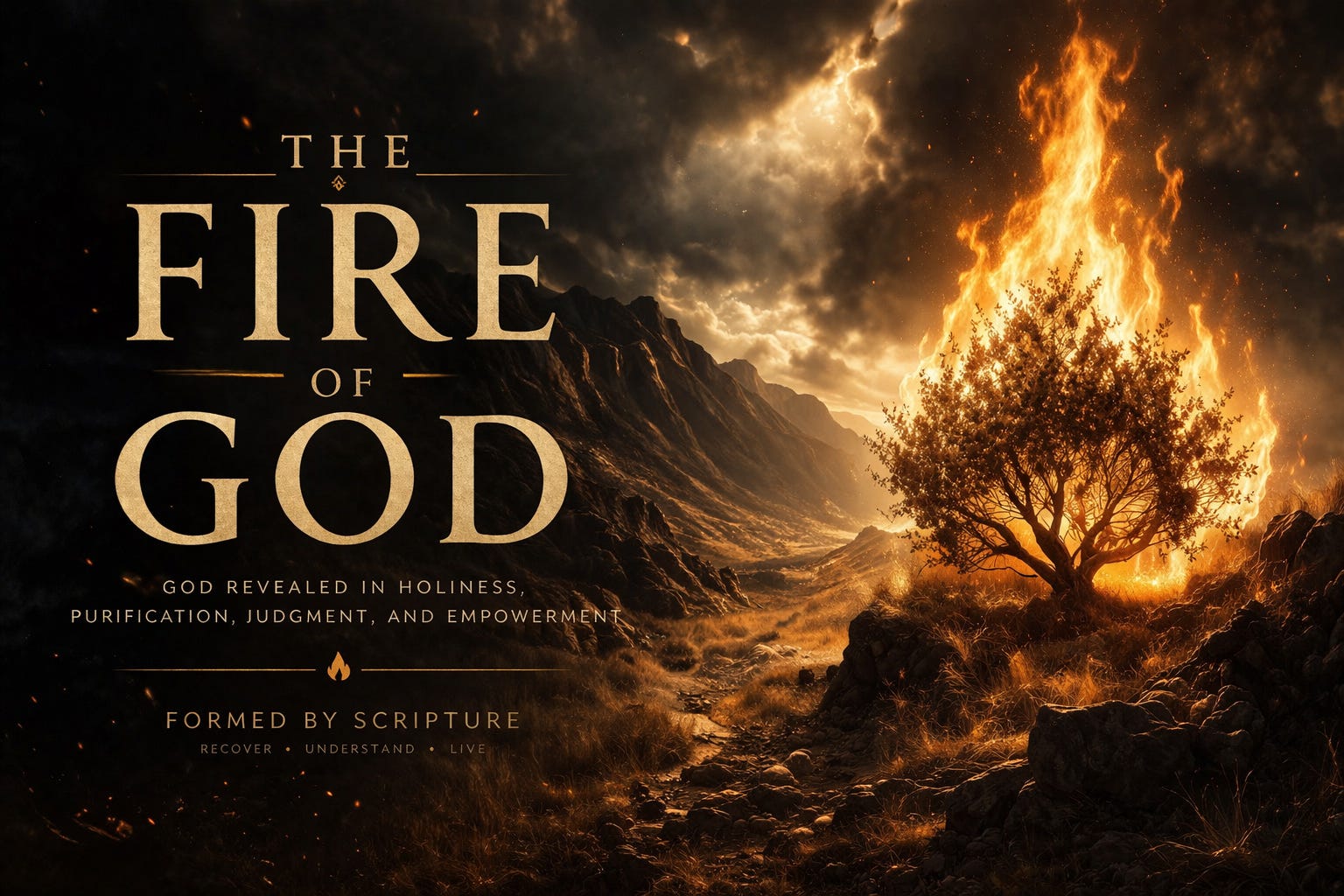
There is a pattern woven throughout Scripture that becomes unmistakable once it is seen. Whenever God draws near to a person in a way that is real, not merely observed but encountered, He does not leave them as they were. His presence does not simply comfort. It confronts, exposes, and ultimately transforms. This is why fire becomes one of the primary ways Scripture describes His self-revelation. Fire is not chosen because it is dramatic, but because it is honest. It reveals what can endure and what cannot, bringing hidden things into the light and consuming what is incompatible with His nature. It does not negotiate with what is false. It removes it.
This reality is not limited to visible moments. Long before fire is seen, it is felt. When the risen Jesus walked with the disciples on the road to Emmaus, they later said that their hearts burned within them as He opened the Scriptures (Luke 24:32). They did not yet recognize Him, yet His presence was already at work, igniting something deeper than emotion. That moment reveals the beginning of divine fire. God does not begin by altering a person’s outward life. He begins within, setting the inner man ablaze, and from that place everything else is drawn into alignment.
God does not set a man on fire to improve him. He sets a man on fire to remake him.
The Fire That Descends
This inward burning finds its visible expression in the moment recorded in Acts 2, where Luke describes how “divided tongues as of fire appeared to them and rested on each one of them, and they were all filled with the Holy Spirit” (Acts 2:3–4). This is not simply a dramatic event marking the birth of the Church. It is the fulfillment and transformation of a pattern that stretches back through the entire story of Israel. Throughout the Old Testament, fire consistently marked the place where God chose to dwell. He revealed Himself to Moses in a bush that burned without being consumed (Exodus 3), descended upon Sinai in fire (Exodus 19), consumed the sacrifices offered before Him (Leviticus 9), and filled Solomon’s temple with such intensity that the priests could not stand to minister (2 Chronicles 7). In every instance, fire testified that God was present, active, and near.
Yet in Acts 2, the pattern reaches its turning point. The fire no longer rests on a mountain, a structure, or a sacred location. It rests upon people. The presence that once marked space now inhabits lives. What was once external becomes internal. What was once approached becomes indwelling. The God who revealed Himself in fire now chooses to dwell within those He fills, not as a distant reality to be visited, but as a present reality to be carried.
The fire has not diminished. It has moved closer.
The Fire That Purifies
The nearness of God’s presence cannot be separated from the reality of His holiness, and holiness does not allow illusion to remain. When Isaiah saw the Lord high and lifted up, his immediate response was not confidence but collapse. “Woe is me,” he cried, “for I am a man of unclean lips” (Isaiah 6:5). The presence of God reveals what familiarity conceals. What once seemed acceptable is suddenly exposed as insufficient, because holiness redefines reality. It is in that moment that purification begins, as a seraph takes a burning coal from the altar and touches Isaiah’s lips, declaring that his guilt is removed and his sin atoned for (Isaiah 6:6–7). Only after this encounter does Isaiah hear the call to be sent.
This order is not incidental. God cleanses before He commissions. The same pattern underlies Pentecost. The fire that rests on the apostles is not merely empowering, but consecrating. It is not only giving them boldness, but preparing them to carry the weight of divine presence. This exposes a tension that runs through every generation. There is often a desire for manifestation without transformation, for power without purification, for visible fire without inward refinement. Yet the fire of God does not coexist with mixture. It exposes it. It confronts hidden sin, dismantles divided allegiance, and brings every competing loyalty into the light.
Fire does not ask permission to change you. It removes everything that refuses to change.
The Work of the Refiner’s Fire
Scripture deepens this understanding by describing God as a refiner, one who applies fire with intention rather than impulse. “He is like a refiner’s fire” (Malachi 3:2), a phrase that captures both the intensity and the purpose of His work. A refiner does not discard the metal. He applies heat until it yields. As it softens, impurities rise to the surface, not because the fire created them, but because the fire revealed them. Once exposed, they can be removed, leaving behind something stronger, purer, and capable of reflecting the image of the one who formed it.
This is how God works within His people. He does not introduce what is impure. He exposes what is already present. He does not abandon the person. He refines them. Yet this also demands discernment, because not everything labeled as fire reflects the nature of God. True fire produces reverence, conviction, and lasting transformation. It quiets what is fleshly and awakens what is spiritual. Counterfeit fire produces noise without depth and movement without change.
God’s fire is not proven by how loud it is, but by how deeply it changes what it touches.
The Fire That Rests
Luke’s language is deliberate when he writes that the fire “rested” on each of them (Acts 2:3). This is not the language of a passing moment, but of a sustained reality. Under the Old Covenant, fire rested on places, marking sacred geography and defining where God’s presence was encountered. Under the New Covenant, fire rests on people, marking transformed lives and redefining how God’s presence is carried. The movement is not merely historical. It is theological. The presence of God is no longer something to visit, but something to inhabit.
This changes the nature of spiritual life entirely. The goal is no longer to reach a place where God dwells, but to live as one in whom He dwells. Even the imagery of tongues as of fire carries this transformation into the realm of speech. Just as Isaiah’s lips were purified before he spoke, so now the people of God speak from lives that have been refined by His presence. What flows outward is shaped by what has been transformed inward.
A man who carries fire does not need to prove it. It becomes evident in what remains after he speaks.
The Fire That Fills
Luke continues by stating that they were “all filled with the Holy Spirit” (Acts 2:4), and this language communicates more than influence. It communicates saturation. This filling is not an addition to an otherwise unchanged life, but a reordering of it. Identity, courage, perception, and purpose are all reshaped by the presence now within. Pentecost is not merely an event to be remembered, but a reality that defines what it means to belong to God in the new covenant.
The same presence that once appeared externally now dwells internally, and where that presence abides, transformation follows. Not artificially, not performatively, but inevitably.
The fire that fills a man does not stay where it started. It spreads through every part of who he is.
The Fire That Spreads
Fire, by its nature, does not remain contained. It moves, it spreads, and it transforms whatever it touches. This is why the effect of Pentecost cannot be confined to a single moment or location. The fire that rests on the apostles begins to extend outward, reaching people, confronting systems, and advancing the message of the Kingdom. Lives are changed not because of spectacle, but because of presence.
This is the nature of true spiritual fire. It cannot be hidden, and it cannot remain isolated. When God sets a person on fire, that reality begins to shape everything around them, not through force or performance, but through the undeniable weight of transformation.
Where real fire burns, something always changes.
The Gospel of Fire
When the crowd responds to Peter’s proclamation, his answer reveals how people enter into this reality. “Repent and be baptized… and you will receive the gift of the Holy Spirit” (Acts 2:38). This is not separate from the fire. It is the means by which one is brought into it. Repentance confronts and burns away the old life. Baptism marks its burial under the authority of Jesus’ name. The infilling of the Spirit brings forth new life shaped by His presence.
The Gospel is not merely information to be understood. It is transformation to be undergone. It purges, cleanses, and recreates, because God’s intention is not simply to inform His people, but to make them new.
The Gospel does not invite you to admire the fire. It brings you into it.
The Fire That Remains
The fire revealed at Pentecost is not a moment to revisit, but a life to inhabit. Scripture consistently calls believers into a posture that sustains what God has begun. A life surrendered to Him (Romans 12:1), shaped by His Word (Jeremiah 23:29), guarded in the Spirit (1 Thessalonians 5:19), anchored in prayer (Acts 1:14), and strengthened in community (Hebrews 10:25) becomes the environment where the flame remains.
The fire is not sustained by intensity, but by alignment. It remains where a life continues to yield to God.
Fire does not stay where it is merely experienced. It stays where it is continually welcomed.
Conclusion
The testimony of Scripture leaves no room for casual interpretation. When God reveals Himself through fire, He is not merely displaying power. He is forming a people. He is drawing them out of what is shallow and into what is real, removing what cannot remain and establishing what reflects His nature. This is not something that can be manufactured or imitated. It is formed through surrender, refined through obedience, and sustained by His presence.
God is not looking for people who are impressed by His fire. He is forming people who can live in it. And the difference between the two is everything.
Reflection
1. What is God currently exposing in me so that He can refine it?
2. Am I pursuing transformation, or simply experience?
3. Does my life reflect someone who carries the fire, or someone who only visits it?
Formed by Scripture
Formed by Scripture exists to help believers recover the story of the Bible, understand the Gospel the apostles preached, and live faithfully under the reign of King Jesus.